Since posting Stigma of Christianity, I have been thinking about the general idea of relevance. As the church, we believe we need to be relevant in our culture influence souls for Christ, and we see that in practice in the scriptures. Paul made a great effort at relevance with sharing the good news with the Greeks by working his explanation through their Tomb to the Unknown God in Athens. All of the Gospels are written so as to be relevant to their audiences. (The Epistles were as well, but I see the Gospels as more missionary in purpose while the Epistles were instructional to the churches.)
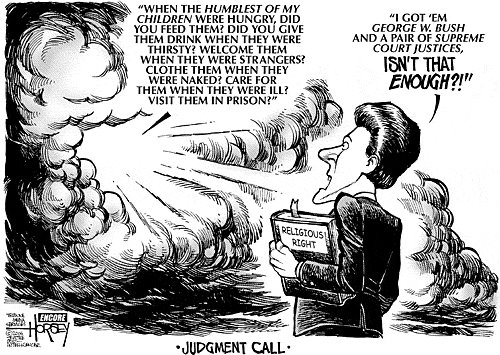
 Today, one of our relevance attempts en mass have been through politics: by-in-large aligning ourselves with one party for religious reasons and defining every political action through the lens of Christianity. Has this been successful? Politically, we're a force to be reckoned with, but we're also the enemy and/or laughing stock of so many that do not align with our stances. Personally, I believe this "religious right" political force has peaked and will wain at least some in the near future.
Has this made the church any more relevant? It has definitely given us more media headlines, but do headlines and relevance align. I'd say no. On a national scale, these headlines and activity have created the very stigma I'm talking about. Relevance comes, in my opinion, when the church is quietly meeting the needs in each of its individual communities, when we are touching lives around us rather than debating issues.
But now I'm brought back to John 15:18-25 where Christ tells us the world will hate us. If we're working to be relevant in our world, then aren't we working to not be hated? My natural tendency is definitely to try not to be hated as best I can within my own moral guidelines.
This seems to be an enigma to me, but I am coming to this conclusion:
I believe our charge is to spread the good news. We are given examples of doing this in many ways: through open-minded discussions, through preaching, with miracles, through our living testimonies, etc. All of these are methods that find relevancy in the situation at hand to better share that gospel. Christ concludes his discussion in John 15:25 with the statement that we are fulfilling the prophecy that "they hated me without reason." So, I'm not to work to be hated. I don't have to worry about that. It's coming in some form no matter what. I'm not to condemn or shout or display banners and protest signs, or push my morality (even though correct according to biblical teachings) upon those who are lost and thus by definition don't follow that same code. I'm to love them, tell them the good news in a way relevant to their situation, and then disciple those that accept that news.
(note: This doesn't mean that I become apolitical or a wet blanket when it comes to morality. I stll intend to vote and to even express my views. But I don't think my religion is best proclaimed through taking political or moral stances on issues.)
Technorati Tags : christianity, stigma, relevance, gospel



 That aside, however, my hearing about this conference came at an appropriate time. It has helped me refocus for the new year on what I believe to be God's directive for my life as a whole - to live a missional life. That's the most important thing. In my current world, one in which we've now lived in a new town for a year and a half, have become very involved in our church, and now have a 6 month old son, I feel like I need to reevaluate how I'm doing here and how I can improve. All of these changes have been life comsuming, but it's time to refocus so that I can, through God's direction and strength, better engage my community and the world with the gospel.
 Anyway, I was listening to Terry Gross interview Bart Ehrman - chairman of the religious studies department at the University of North Carolina in Chapel Hill and most recently the author of Misquoting Jesus: The Story Behind Who Changed the Bible and Why. This little book of his "explores how scribes -- through both omission and intention -- changed the Bible (see npr synopsis of the Fresh Air interview and book description
  I have this slightly addictive little add on to my browser (I use Firefox, but I don't think it's required) called "StumbleUpon." Once you install the bar and choose your topics of interest, just click a button and randomly stumble around the internet to new sites in your topic list. Sites are included by other "StumbleUpon" members who recommend it. It's a neat little tool that can easily consume a lot of my time. Check it out.



 Posts
Posts

